Monetization project | Sprinto
Hi there, we'll take this one step at a time!
If you struggle with a blank canvas, use this boilerplate to start. Remember, this is a flexible resource—tweak it as needed. Some sections might not apply to your product, and you might come up with great ideas not listed here. Don't let yourself be restricted.
This is not the only format, we would love to see you scope out a great format for your product!
Go wild and dive deep—we love well-researched documents that cover all bases with depth and understanding.
Reminder: Delete the boilerplate once you've made your project
Product is already monetising
Summary of Litmus Test:
| ICP | Retention | Engagement | Willingness to Pay | Verdict |
|---|---|---|---|---|
ICP-1 | Weak; early churn | Shallow; single framework only | Very price sensitive ($3–5K ARPU) | Needs Focus |
ICP-2 | Improving, but still patchy | Basic; few core users | Cautious spenders ($5–10K ARPU) | Needs some Focus |
ICP-3 | Stable; improving over last year | Strong; multiple features + frameworks | Moderate–high ($10–20K ARPU) | Pass |
ICP-4 | Strong; smile-shaped curve | High; automation, Trust Center, Security Q use | High WTP ($20–40K ARPU) | Pass |
ICP-5 | Early but promising; long-term stickiness | Deep needs; complex GRC alignment | Very high ($40K+), requires high-touch support | Needs some Focus |
ICP Details
Criteria | Startup finding PMF(ICP 1) | Early Scaling SaaS experimenting marketing(ICP 2) | Scaling channels effectively(ICP 3) | Mid-market SaaS company(ICP 4) | Enterprise SaaS(ICP 5) |
|---|---|---|---|---|---|
Name | Early-stage SaaS startup | Growing SaaS scale-up | Mature scaling SaaS | Mid-market SaaS | Large enterprise SaaS |
Company Size | 1–50 | 50–100 | 100–500 | 500–2000 | 2000+ |
Nature of their product and architecture | Basic, one product with simple functionality. Tech architecture is basic and not scalable. | Majorly one product with simple functionality in few areas and more complex functionalities in customer critical areas. Parts of the tech architecture are getting more scalable but most of it to quickly unblock customer or deals. Pricing plans are very basic or officially doesn't exist | Generally One or more products. Dedicated product teams to focus on most areas of the product. Product starts to become more customisable to accomodate variety of customers. Major transformation in tech architecture is required or in-progress to handle larger customers. | Multiple products, major product has reached maturity and now is highly customisable. Other products are showing that promise. Tech architecture in major products are now mature to support scale. Company focussing on other product lines. | All of the products are highly scalable and with stable tech architecture. Growth has slowed down. Product is extensively vast and requires proper expertise on customer's end to implement. |
Engagement Driver | Quick SOC 2 reports for sales deals (solves immediate pain). | Alerts for control failures (proves ongoing value). | Multi-framework dashboards (saves time for compliance teams). | Vendor risk modules (critical for global audits). | Custom reports for execs (aligns with governance goals). |
Churn Risk | Manual work post-audit → "Why keep Sprinto if compliance is done?". Increase in cost of AWS, Azure due to compliance | Too many false alerts → seen as "noisy tool." | Complex setups → "Not worth the effort" if ROI isn’t clear. Lesser number of integrations | Siloed teams → "Only security uses it, others ignore.". | Budget cuts → "Compliance tools are first to go." |
Retention Tactic | Auto-enroll in "Continuous Monitoring" post-audit, highlight new integrations. | Quarterly health checks + customize alert thresholds. | ROI calculator + dedicated TAM for onboarding. |
|
|
User Segmentation |
|
|
|
|
|
Location | Major tech hubs (US, UK, India, Germany) | Major tech hubs (US, UK, India, Germany) | Major tech hubs (US, UK, India, Germany, Other EU countries) | US/EU, global presence | Global (distributed) |
Funding Raised | Seed to Series A (up to $10M) | Series B (~$10-50M) | Series C/D (~$50M-200M) | Series D+ (~$200M+) | Public or Large private |
Industry Domain | SaaS, fintech, productivity, EdTech, High-tech research firm | SaaS, FinTech, HRTech, HealthTech | SaaS, HealthTech, Finance, AI, Ecommerce | SaaS, Enterprise Software, regulated industries | Enterprise software, tech conglomerates |
Stage of the company | Finding Product-Market Fit | Early scaling, aggressive growth | Scaling operations rapidly | Expanding globally, mature | Established, large scale operations |
Organization Structure | Flat, founders-led, no dedicated compliance team | Founder, CTO, CFO | Small dedicated security team | Dedicated compliance/security teams | Large dedicated compliance/security divisions |
Influencer | Founder, CTO | CTO, VP of Engineering | VP Security, Head of Compliance, CTO | CISO, CIO, Chief Risk Officer | Chief Compliance Officer, CISO, Chief Risk Officer |
Decision Maker | Founder, CTO | CTO, Security lead | CISO, VP Security | CISO, Compliance Officer | CIO, Compliance head |
Decision Blocker | Other founder, Investor | CFO, Investor | CFO, some senior members in engineering team(engineer team too occupied) | Internal bureaucracy | Multiple stakeholders, extensive approvals |
Frequency of use case | Getting compliance (e.g., SOC2) for the first time to unblock first set of prospect/deals | Initial compliance to scale fast or unblock few large deals | Continuous compliance operations: Experimenting with how the overall compliance framework could work and what will not work. | Multi-framework ongoing audits, some of the processes like vendor management and access reviews are mature while policy reviews, training, risk management is getting optimised | Continuous multi-framework audits across the globe. All of the process from risk management, vendor management, access reviews, policy reviews etc are spread across multiple teams who manage them. |
Products used in workplace | Google Workspace, Slack, AWS, GitHub | AWS/Azure/GCP, Notion, Height, Slack, GitHub, HRIS, vulnerability scanners, Hubspot | AWS/Azure/GCP/Oracle, Okta or similar tools, GitLab/Github, Jira/Asana, HRMS tools, background verification tools, vulnerability scanners, incident management tools | Azure/AWS/GCP, ServiceNow/Jira, Salesforce, Workday | Enterprise stack (Azure, AWS, Oracle), SIEM tools |
How technically sophisticated are the decision makers? | High (engineer-led) | High (dedicated DevOps)- CTO and one of the founder are generally from tech background | Medium - Compliance team is just starting to form. Company is not in position to hire people with huge experience. While CTO is technically sound, compliance team is not that much. | Medium-high (established teams) but compliance team are just not that mature. Role of CTO/VP of engineering in decision making starts to reduce. | High (large tech/security teams). Compliance and security team has huge experience and are technically sound |
Organizational Goals, current scenario and how compliance works(without Sprinto) |
|
|
|
|
|
Driven by innovation or reducing risk? | Innovation-driven (need compliance as deal enabler) | Innovation-focused, compliance to facilitate growth | Balanced (innovation + risk management) | Risk management (compliance as reputation builder) | Risk aversion (compliance critical) |
Preferred Outreach Channels | Email, Slack communities, founder referrals | LinkedIn, Email, webinars, Slack, founder referrals | LinkedIn, email, security conferences | Industry conferences, analyst reports, direct email | Enterprise sales teams, direct outreach, Gartner |
Conversion Time | Short (2-4 weeks) | Moderate (1-2 months) | Moderate (1-3 months) | Long (3-6 months) | Very long (6-12 months) |
GMV | <$1M | $1M-$10M | $10M-$50M | $50M-$200M | >$200M |
Growth of company | High (50%+ YoY) | Very High (75-100% YoY) | High (40-75% YoY) | Moderate to High (20-50% YoY) | Steady (10-20% YoY) |
Motivation | Quickly achieve compliance to close deals | Minimize manual compliance tasks, rapid growth | Automate, scale compliance efficiently | Robust compliance, audit readiness | Risk reduction, corporate governance |
Where they spend time? | Slack, Twitter, LinkedIn, Product Hunt | LinkedIn, Twitter, Webinars, Slack Communities | LinkedIn, webinars, industry events | Industry forums, analyst reports, LinkedIn | Gartner, analyst conferences, industry forums |
Where they spend money? | Engineering, Product dev tools | Marketing, Product scaling, Dev tools | Security tools, DevOps, compliance automation | Compliance/security tools, integrations | Enterprise software, compliance & risk tools |
Power/Core/Casual Based classification
| Segment Name | Segment Description | Key Features | Frequency of usage | Engagement Drivers | Churn Risks |
|---|---|---|---|---|---|
Power Users | Regularly use multiple modules/features; integrate Sprinto deeply into workflows. Typically Compliance leads at mid-market or larger firms. | Multiple frameworks (SOC2, ISO, HIPAA), Trust Center, Continuous monitoring, Detailed risk dashboards | Daily to Weekly | Automation, efficiency gains, central hub for all compliance needs | Complexity of integrations, cost vs. perceived value |
Core Users | Regular but focused use; use a few features actively, mainly compliance managers at growing startups and scale-ups. | Single framework or limited multi-framework, Compliance dashboards, Evidence uploads, Audit preparation tools | Weekly to Monthly | Simplified compliance workflows, clear audit readiness visibility | Lack of feature depth, alternative solutions emerging |
Casual Users | Occasional users; typically DevOps engineers, auditors, or startup founders who engage only when explicitly needed (audit cycle). | Integration setup, alert response, evidence submission/review | Monthly or Audit-Cycle only | Audit cycle pressure, specific task completion (alerts, evidence upload) | Infrequent usage reducing perceived ongoing value |
If your product is already monetising
Summarised Litmus Test
| ICP | Retention | Engagement | Willingness to Pay | Verdict |
|---|---|---|---|---|
ICP-1 | Weak; early churn | Shallow; single framework only | Very price sensitive ($3–5K ARPU) | Needs Focus |
ICP-2 | Improving, but still patchy | Basic; few core users | Cautious spenders ($5–10K ARPU) | Needs some Focus |
ICP-3 | Stable; improving over last year | Strong; multiple features + frameworks | Moderate–high ($10–20K ARPU) | ✅ Pass |
ICP-4 | Strong; smile-shaped curve | High; automation, Trust Center, Security Q use | High WTP ($20–40K ARPU) | ✅ Pass |
ICP-5 | Early but promising; long-term stickiness | Deep needs; complex GRC alignment | Very high ($40K+), requires high-touch support | Needs some Focus |
Summary
Sprinto is well-positioned to grow revenue through expansion within its existing customer base. Sprinto doesn't have any free plans just some features or sub-products which are free but platform is paid. Cross-sell and up-sell opportunities—like additional frameworks, Trust Center, Security Questionnaire, and higher-tier plans—align with real usage signals such as audit milestones, feature engagement, and org complexity.
These targeted experiments focus on:
- Increasing account value without adding new logos
- Offering the right product at the right time, using usage and maturity triggers
- Improving retention by solving evolving customer needs
Together, these initiatives help Sprinto grow efficiently while deepening customer stickiness.
Cross-Sell Experiments
Experiment (Focus) | Target Segment | Trigger / Signal | Pitch / Message | Offer | Channel | Success Metric |
|---|---|---|---|---|---|---|
Add Compliance Framework | Customers (ICP-2 or ICP-3) who have completed one framework (e.g. SOC 2 or ISO 27001) on Starter/Pro plan; moderate maturity (first audit done). | Upcoming secondary audit or certification deadline (e.g. new ISO deadline); or expressed interest in additional certifications during CSM call/email. | “Congratulations on achieving [Framework 1] compliance! Accelerate your risk management by adding [Framework 2] (e.g. ISO or HIPAA) in the same platform. You’ll save time with unified evidence collection.” | Discounted bundle pricing or free add-on of initial controls for the new framework; pilot support for certification. | Email from Account Manager; in-app notification at login; webinar invitation for multi-framework benefits. | Number of new frameworks purchased; incremental ARR from framework add-ons; win-rate on targeted pitches. |
Private Trust Center | Enterprise/mid-market customers (ICP-3/4) handling multiple prospect audits; high usage of document-sharing features; often receive new vendor trust requests. | Spike in support tickets for compliance evidence, or customer feedback requesting branded “shareable compliance site”; multiple inbound questionnaire requests. | “Streamline due diligence with your own Private Trust Center. Share proof of compliance (reports, policies, certifications) with prospects instantly in a branded portal.” | One-time setup fee for Trust Center + monthly access fee; or free 30-day trial to build and show a customized portal. | Demo call by Customer Success or CSM; follow-up email with screenshots; discussion during renewal planning. | Number of Trust Center sign-ups; usage stats (evidence views/shared); reduction in support load for evidence requests. |
Security Questionnaire Add-on | Customers on Starter/Pro plans without the questionnaire module, especially those in ICPs (like Fintech or HealthTech) with strict vendor vetting processes; or trial users who did not upgrade. | Recent receipt of security questionnaire (e.g. via support ticket) or inbound query “How do I respond to vendor RFPs?”; web analytics showing visits to product FAQ on questionnaires. | “Respond faster to vendor RFPs and custom audits. Our Security Questionnaire module automates answers with your compliance data. Spend 90% less time on questionnaires.” | Access to full questionnaire module for a discounted period (e.g. first year at 50% off) or upgrade plan that includes it; dedicated onboarding session. | Targeted email (triggered by support tag); in-app banner; CSM outreach with case study of faster RFP responses. | Conversion rate on questionnaire offers; reduction in manual response time (customer feedback); added MRR from questionnaire sales. |
Up-Sell Experiments
Experiment (Focus) | Target Segment | Trigger / Signal | Pitch / Message | Offer | Channel | Success Metric |
|---|---|---|---|---|---|---|
Tier Upgrade (Plan Increase) | Growing customers on lower tiers (Starter → Professional, or Pro → Advanced) in ICP-2/3; usage nearing plan limits (controls, integrations, or user seats). | Usage thresholds hit (e.g. 80% of user seat cap, control count high); frequent logins/feature use; feedback “we need more [feature]”. | “Your team is growing and Sprinto usage is high – move to the next plan to unlock Advanced Risk Management and unlimited controls. Stay ahead of audits with extra features.” | Offer a time-limited discount on the higher plan for first term; or bonus services (e.g. strategy session) if upgraded by renewal. | In-app notification when limits approach; personalized email from AE highlighting ROI; CSM growth review meeting. | Number/% of customers upgraded; increase in ARR per account; reduction in limit-related support tickets. |
Advanced Risk Management Module | Customers on Pro or Advanced tiers managing multiple frameworks or large asset inventories; medium/large companies (ICP-3/4). | Repeated usage of basic risk tools; multiple open risk items; request for more granular risk scoring; or survey feedback indicating need for deeper analysis. | “Unlock Sprinto’s Advanced Risk Management for full visibility: dynamic risk scoring, heat maps and automated vendor risk assessments. Proactively address issues before audits.” | Package Advanced Risk module as add-on (or included in higher plan), with discounted pilot period or bundled with training. | CSM/AE presentation using current risk data; email with demo video; in-app prompt when viewing risk dashboards. | Adoption rate of risk module; reduction in manual risk review effort; feedback NPS on risk capabilities. |
Custom SLAs & Premium Support | Enterprise customers (ICP-4/5) with complex org structures or global teams; high support ticket volume; compliance-critical operations. | Frequent high-priority support tickets; growth in organizational complexity (multiple zones/departments); direct feedback on needed SLAs. | “Ensure mission-critical compliance operations with Custom SLAs. Upgrade to Enterprise plan for guaranteed response times, dedicated support, and tailored onboarding.” | Upgrade incentive (e.g. first-year discount) to Enterprise tier; or add-on premium support/SLA package. | Renewal meeting or executive business review; CSM email demonstrating ROI of dedicated support; reference from similar enterprise. | Number of accounts moving to Enterprise tier or adding SLA package; SLAs met (uptime, response time); customer satisfaction (CSAT) on support. |
Substitute Pricing
Work on the following aspects:
- What are your customers paying for?
- How does your product stand out?
- How do you position your product?
Compliance Automation: Sprinto vs Alternatives
Manual, consultant-led compliance is typically “time-consuming and repetitive”, whereas modern automation platforms streamline work (automating evidence collection, continuous checks). Enterprise GRC tools (AuditBoard, ServiceNow, etc.) are comprehensive but complex, and cloud-focused SaaS compliance platforms (like Vanta/Drata) target ease and speed Sprinto’s platform is tailored for cloud-native startups, with pre-built frameworks and adaptive automation. The table below compares these approaches across key non-monetary criteria:
Attribute | Manual (Consultant) | GRC Tools (AuditBoard, ServiceNow, etc.) | Compliance Tools (Vanta, Drata, etc.) | Sprinto |
|---|---|---|---|---|
Ease of use | Low – Manual processes (spreadsheets/docs), very error-prone. | Moderate – Feature-rich but complex (AuditBoard ≈8.9/10 ease). | High – Intuitive UI and guided workflows (e.g. Vanta automates evidence). | High – Designed for simplicity (rated 9.2/10) with a low-touch UX. |
Automation | None – All tasks (evidence collection, control checks) are done manually. | Partial – Some automation (workflows, alerts), but much remains manual. | High – Continuous monitoring and auto evidence collection. | High – End-to-end automation (Sprinto “captures evidence continuously”). |
Setup time | Very long – Consultants often spend months on initial compliance. | Long – Enterprise deployments need significant configuration and training. | Short – Guided onboarding in days/weeks for standard frameworks. | Short – Pre-built programs and expert onboarding enable go-live in days/weeks. |
Customizability | Very high – Compliance processes can be fully tailored by experts (manual effort). | High – Deep customization of workflows, policies, reports (e.g. customizable templates). | Moderate – Custom controls/frameworks allowed (Vanta lets you define your own) but less flexible. | Moderate – Preset frameworks with some configuration; less freeform than general GRC tools. |
Frameworks supported | Any – Consultants can address any standard manually (SOC 2, ISO 27001, HIPAA, etc.). | Many – Built for broad regulations (SOX, GDPR, HIPAA, etc.) with pre-built templates. | Broad – Covers major frameworks by default (SOC 2, ISO 27001, HIPAA, PCI, GDPR, etc.). | Broad – Supports key cloud frameworks (SOC 2, ISO 27001, GDPR, HIPAA, etc.). |
Maintenance | High – Continuous manual updates of evidence/controls (risk of audit fatigue). | High – Dedicated team needed to update controls and risk data over time. | Low – Automated monitoring keeps controls current; teams handle exceptions. | Low – Automated checks greatly reduce upkeep; users report only a few hours of effort per period. |
Audit support | Ad-hoc – No integrated audit features; evidence is shared via documents. | Strong – Built-in audit trails and management (centralized audit tracking). | Good – Reporting and trust centers facilitate audits. | Strong – Audit-ready (continuous evidence capture; platform is “audit-friendly”). |
Perceived value | Low – High consultant fees and slow pace often yield poor ROI. | Enterprise-cost – Very expensive, justified only at large scale. | Moderate to High – Easy to start but pricing can scale quickly (Sprinto is often cheaper) | High – More affordable than Vanta/Drata with similar automation + stronger expert support |
Typical users | Small teams/first-time compliers (startups/SMBs on initial audit). | Large enterprises – Heavily regulated industries (finance, healthcare, tech). | Startups and SMBs – Tech companies needing streamlined compliance. | Cloud-native startups/SMBs – Non-technical teams seeking a fast, low-touch solution. |
Sprinto – RFM-Based Monetisation Design
Objective:
Use RFM (Recency, Frequency, Monetary) analysis to identify which user segments (Casual, Core, Power) Sprinto should monetise more, retain better, or serve at lower cost — based on usage patterns, plan alignment, and pricing sensitivity.
🔍 Segment Overview
Segment | Recency | Frequency | Monetary (ARPU) | Typical Plans | Churn Risk | Upsell Strategy |
|---|---|---|---|---|---|---|
Power (ICP-4/5) | High (daily/weekly) | High (multi-framework) | High (>$30K) | Advanced / Enterprise | Medium | Add frameworks, premium SLAs, custom support |
Core (ICP-2/3) | Moderate (weekly) | Medium (1–2 frameworks) | Medium (~$15K) | Professional / Advanced | Medium | Upsell add-ons, gated features, audits |
Casual (ICP-1/early-2) | Low (monthly/audit-cycle) | Low (task-only) | Low ($3K–$8K) | Starter / Entry | High | Self-serve onboarding, limited CSM |
Power Users deliver highest ARPU and are least price sensitive, but expect visible ROI and support.
Core Users are upsell candidates, but sensitive to complexity or feature gating.
Casual Users are volatile — often churn due to low usage or limited perceived value.
Pricing Elasticity Simulation (Illustrative)
Price ↑ | Retention (Casual/Core/Power) | Revenue Change |
|---|---|---|
0% | 80% / 90% / 95% | Baseline |
+10% | 75% / 87% / 94% | +7–10% |
+20% | 70% / 85% / 93% | +10–12% |
Moderate pricing increases can boost total revenue if targeted at Core/Power users. But Casual user churn rises sharply with price hikes.
Key Monetisation Moves
- Power Users
- Retain with CSMs, audits, premium frameworks.
- Upsell: advanced risk module, security questionnaires, audit bundles.
- Core Users
- Gate features (e.g., Trust Center, deeper dashboards).
- Encourage upgrades via nudges and bundle discounts.
- Casual Users
- Focus on automation and audit-specific touch-points.
- Offer lightweight CSM/onboarding. Annual prepaid pricing helps.
Strategic Takeaways
- Monetisation should match value delivered: Power users justify premium pricing + touch, Casual users need low-cost scalability.
- RFM helps prioritise investment across accounts.
- Align pricing plans (Starter → Enterprise) with usage + ICP sophistication.
When to charge?
Goal:
Identify the right time to introduce pricing or upsell based on perceived value creation moments (Aha vs. Happy), competitor benchmarking, and user benefit alignment.
Step 1: What Determines Value in Sprinto?
Goal Type | Sprinto Value Delivered |
|---|---|
Functional | Automates compliance controls and evidence collection across frameworks (SOC2, ISO etc) |
Financial | Reduces audit prep time by up to 80%, saving $30K–$50K per audit (esp. for ICP 3–5) |
Personal | Helps compliance owners reduce stress, increase internal visibility |
Social | Trust Center displays certifications publicly → boosts brand credibility & conversions |
Value for users increases as they move from setup → automation → audit → showcasing wins → scaling frameworks.
Aha vs. Happy Moments
Moment Type | When it Happens | Perceived Value | Actionable Touchpoint |
|---|---|---|---|
Aha | First 1–2 weeks: User sees controls auto-filled via integrations | “Wow, this saves me tons of time!” | Setup complete + 3 key integrations |
Happy | Audit readiness achieved; public Trust Center published | “This just got me certified + helps sales!” | Audit milestone hit + Trust Center live |
Best time to upsell/cross-sell = just after Happy Moment (e.g., offer 2nd framework after SOC 2 completion).
Step 2: Competitor Benchmarking
Competitor | Price Range | Setup Time | Consultant Required | Value Difference |
|---|---|---|---|---|
Sprinto | $5K–$40K+ (flexible) | Fast (2–8 weeks) | No | Automated, customizable, cheaper |
Vanta/Drata | $10K–$50K | Medium | No | Good UI, similar automation |
AuditBoard | $40K+ | Slow | Yes | Manual-heavy, complex setup |
Consultants | $30K–$80K+ | Very Slow | Yes | Manual, high cost, fragmented ownership |
Sprinto is 20–40% cheaper than Vanta/Drata on average, with faster time to audit and no consultant required.
Step 3: Quantify Perceived Value
ICP | Avg. Time Saved (vs. manual) | Cost Saved (Audit) | Perceived Value Drivers |
|---|---|---|---|
ICP-1/2 | 30–50 hours | $5K–$10K | Low friction, easy automation |
ICP-3 | 100–200 hours | $15K–$25K | Time + Reduced internal effort |
ICP-4/5 | 300+ hours | $30K–$50K+ | Control, customization, deep insights |
Example: A 200-employee SaaS startup on Professional Plan saves $20K+ in audit effort vs. manual/consultant approach — validating a $15K–$20K/year pricing.
Step 4: Perceived Value vs. Perceived Price Map
User Stage | Perceived Value | Perceived Price | Sprinto Action |
|---|---|---|---|
Pre-onboarding | Low | Low | Freely offer integrations + sandbox |
1st Week (Aha) | Medium | Medium | Lock in with onboarding plan + offer add-ons |
Audit milestone (Happy) | High | Medium | Cross-sell 2nd framework, Trust Center |
Post-certification (Scaling) | Very High | High | Upsell to Advanced/Enterprise plan |
Charge after the Aha moment, but cross-sell/upsell after the Happy moment, when ROI is clear and tangible.
Summary
- Sprinto delivers strong functional + financial value early in the journey.
- Pricing should be introduced right after users experience control automation (Aha).
- Major expansions (like frameworks, Trust Center, Risk Module) should be pitched post-certification (Happy).
- Sprinto wins by doing more, faster, and cheaper than competitors — position it accordingly.
What to Charge For — Sprinto
Core Value Proposition:
Sprinto helps cloud-native businesses get audit-ready fast and stay continuously compliant — through automation, integration-first workflows, and audit-aligned tooling.
Monetization Anchors
| Pricing Anchor | Priority | Why it Matters | How Sprinto Applies It |
|---|---|---|---|
Access (Feature/Tier) | Primary | Customers get access to the platform based on their complexity (team size, frameworks, features). This is predictable, scalable, and aligns with value delivery. | Starter → Advanced → Enterprise tiers unlock deeper automation, more frameworks, CSM support, etc. |
Outcome (Audit Readiness) | Secondary | The ultimate value customers seek is certification. Sprinto doesn’t charge for outcomes directly, but the pricing implies delivery of this success. | Customers pay for the platform annually, expecting Sprinto to get them audit-ready faster. |
Shareability (Trust/Questionnaires) | Tertiary | Sharing compliance (publicly or with vendors) is valuable. This can be monetized in advanced tiers or as separate upgrades. | Trust Center and Security Questionnaire features are limited in basic plans and unlock fully in higher tiers. |
Time-Based or Usage Billing | Not applicable | Sprinto is not a per-use or consumption-based tool. Pricing is annual and feature-based; usage volume is not the billing driver. | Platform is billed yearly based on user scale, frameworks, features – not consumption or logins. |
Summary
- Primary model: Access-based tiered pricing by features, frameworks, and company size.
- Secondary layer: Value justified by outcome (audit readiness) — even if not billed per certification.
- Optional/tertiary monetization: For shareability use-cases (Trust Center, Security Qs).
- Avoid time/usage pricing – Sprinto’s value is in automation and outcomes, not usage volume.
Pricing Strategy Models for Sprinto (B2B Compliance SaaS)
Sprinto’s goal is to balance rapid acquisition of startups (ICP-1/2) with expansion revenue from mid-size to enterprise (ICP-3–5). The table below outlines three pricing models that address different segments and value perceptions. Each model includes geographic adjustments (e.g. India vs US) and ties price to value delivered (time/cost savings). Citations show best practices in SaaS pricing, value-based models, and geographic pricing.
| Pricing Model | ICP Focus | Price Structure | Rationale | Perceived Value Gap | Expected Impact |
|---|---|---|---|---|---|
Tiered Subscription (Flat Fee) | ICP-1 & ICP-2 (startups & small teams), with higher tiers for ICP-3–5 (growth/enterprise) | Fixed annual fees by tier (e.g. Startup : $3–5K; Business : $5–10K; Growth : $10–20K; Enterprise : $20–40K+). Regions priced by PPP (e.g. India ~60–70% of US/EU). | Simple, easy-to-sell packages. Clearly communicates features/price. Matches common SaaS strategy of multiple plans (low entry for SMBs, high tier for enterprises). | High value for startups (ROI is large relative to low cost). Mid-market customers may perceive overpayment if their usage is light. Enterprises see full feature-set but pay premium. There is risk of “leaving money on the table” if large clients demand more value than the top tier provides. | Fast sales to SMBs (short cycles). Predictable revenue from each segment. Good initial market penetration. Limits negotiation complexity. However, may stall if large customers need more customization or value than a fixed tier offers. |
Hybrid (Base + Usage) | ICP-1 to ICP-4 (startups through growth) and expansion into ICP-5 | Base subscription fee (e.g. ~$5K/year) + variable fees (e.g. per user, per compliance audit/module, or per automated procedure). Seat- or usage-based tiers scale with volume. Geo-adjust base fees (India ~60% of US). | Aligns cost with actual usage and customer size. Lowers entry barrier for small teams (small base fee) while capturing more from heavy users. Encourages expansion: as a company grows or adds compliance modules, they pay more (organic upsell). Mirrors models like Snowflake’s mix of base + usage. | Customers pay roughly in proportion to value received (fairness). Startups can start cheap, large adopters naturally pay more. Some customers may worry about bill unpredictability. Properly communicated, high-growth companies see price rising only as they gain more efficiency (natural alignment). | Good entry for small teams and high expansion with growth. Natural account growth: if a customer’s compliance needs double, spend roughly doubles, driving revenue. Potential downside: usage-based models can lengthen enterprise sales cycles (the need to estimate usage). Requires forecasting usage in negotiations, possibly adding sales complexity. Overall, strong expansion engine (Bessemer notes 2–3× account revenue with systematic growth pricing). |
Outcome/Value-Based Pricing | ICP-3 to ICP-5 (mid-size to large enterprises) | Customized pricing tied to outcomes or ROI. Examples: a flat fee plus a bonus tied to achieving compliance milestones (e.g. SOC 2 report delivered), or pricing as a percentage of estimated cost savings. Multi-year contracts with success metrics. Regional multipliers apply to base fee component. | Prices are set on measurable customer outcomes , not just features. This premium model focuses sales on business value (e.g. “we save you 15% of audit costs, so we price at X% of that saving”). It resonates with enterprises that demand ROI. Featuring Pilot/POC phases (low initial price) can speed closing. | Customer value-perceived is high because they pay according to ROI. For example, if automation yields ~20% cost savings (per studies), pricing at a fraction of that frames Sprinto as investment. There’s less perceived risk: clients pay for actual business impact. However, it requires trust that Sprinto will deliver the outcome, so it often involves careful negotiation and proof (structured deals). | Potential for very high deal sizes and retention (ROI alignment encourages renewals). Creates strong alignment: as customer value grows, Sprinto’s revenue grows. Sales cycles may be longer due to complexity, but outcomes-based deals lock in high expansion and renewal rates (SaaS Capital found structured renewals ~94% retention). Premium pricing justifiable to large firms, unlocking revenue that flat tiers might miss. |
Sprinto’s pricing needs to balance value delivered with what customers are willing to pay — and that varies by customer size and region. Compliance automation can save companies ~20% in costs and boost efficiency by ~15%, so the sweet spot is pricing well below that perceived value.
- Tiered Pricing works best for startups (ICP-1/2) — it’s simple, fast to sell, and easy to understand. But it can feel limiting for larger customers who want more flexibility.
- Hybrid Pricing (base fee + usage) grows with the customer. It reduces upfront friction and enables powerful expansion as usage increases. The trade-off? Slightly longer sales cycles due to complexity.
- Outcome-Based Pricing is ideal for large enterprises (ICP-4/5) — where price is linked to business results. It takes more trust and effort to close, but unlocks higher revenue and long-term retention.
Different geographies also have different budgets. Sprinto can adjust pricing by region (e.g., India ~50–60% of U.S. rates), just like Spotify does, to stay affordable without sacrificing growth.
In short: Startups need simple pricing. Growing companies scale usage. Enterprises pay for results. Sprinto should adopt a hybrid pricing strategy that evolves with the customer — unlocking value at every stage.
Pricing Page
(Understand the existing user discovery flow for pricing and try to understand why things are being done they are currently)
Pricing Page Design
(Step 1 - Analyze the existing pricing page objectively)
(Step 2 -Re-design the Pricing Page)
(Step 3- Add reasoning for the same)
Current Pricing & Plans Page
Sprinto currently doesn't have Public Pricing Page, this page is available only after login into customer account that too about pricing. Discussions about plans and pricing are dependent on lot of factors so there can be no fixed pricing, but plans can be fixed.
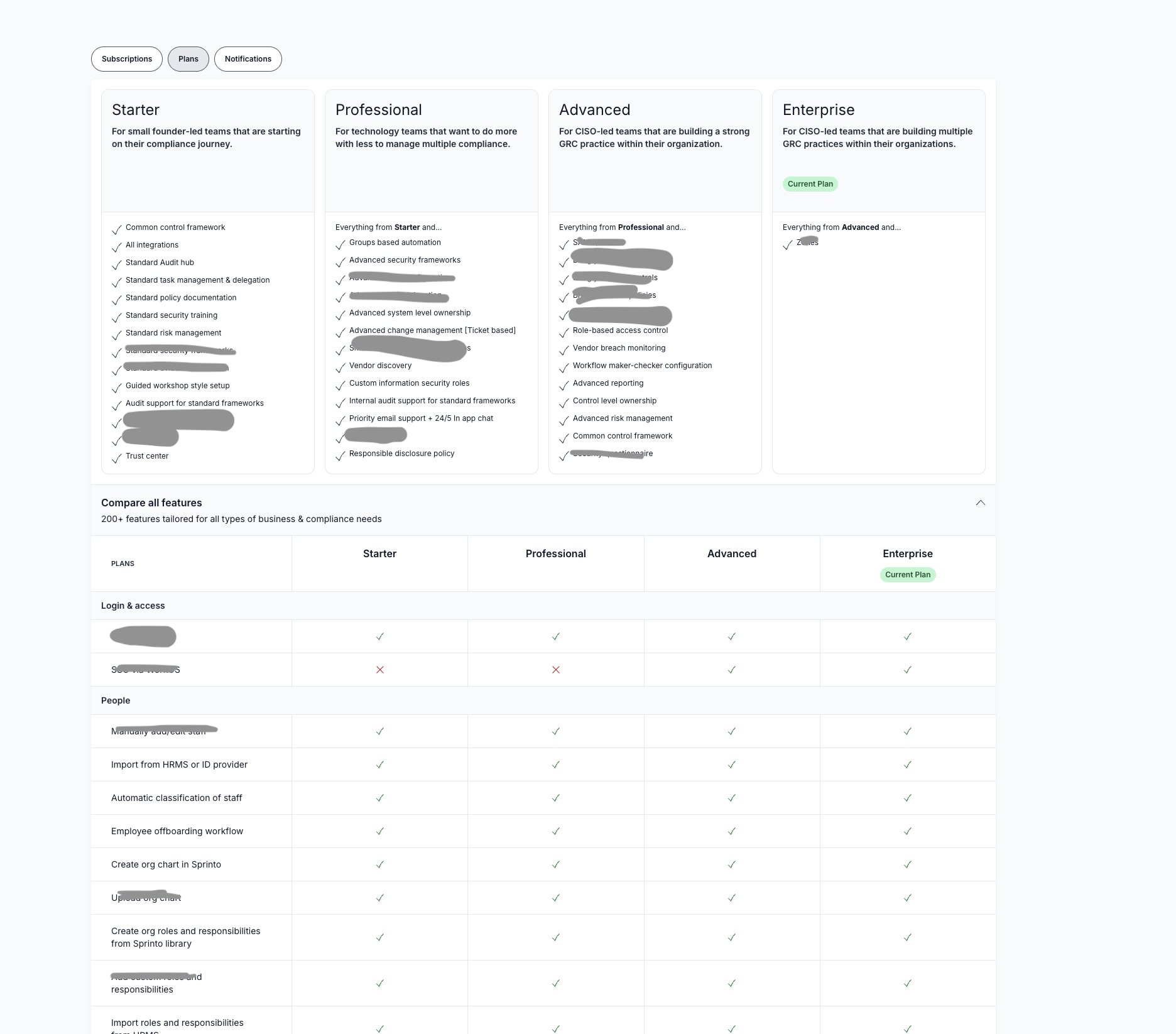
What’s Missing in Sprinto’s Current Pricing Page (Post-Login Settings)
- Not Publicly Discoverable
Unlike competitors like Vanta or Drata, Sprinto’s pricing is hidden behind login walls. Prospects exploring the site can’t evaluate pricing tiers unless they go through Sales. - Zero Context or Positioning
The current pricing view inside Settings just lists plans and features. There’s no explanation of who the plan is for, why it’s different, or how to choose. That’s friction for both existing and evaluating users. - No CTAs or Upgrade Nudges
There’s no guidance like “Upgrade to Advanced to unlock X” or “This feature is available in Pro+ plans.” Missed opportunity for upselling or encouraging plan exploration. - Missing Visual Cues
The design is clean but static. No badges like “Most popular,” no feature highlights, no usage of pricing psychology (middle bias, anchoring, etc.). - Lacks Proof or Trust
No customer logos, testimonials, or trust elements around plan value. No credibility builders to justify plan differences. - Zero Personalization
The page doesn’t adapt based on ICP or user type. A startup and a large enterprise see the same layout, though they care about different things. - No highlight that there is Discounts for early stage startups in starter plans
Sprinto Pricing Page — Redesigned for Discovery & Conversion
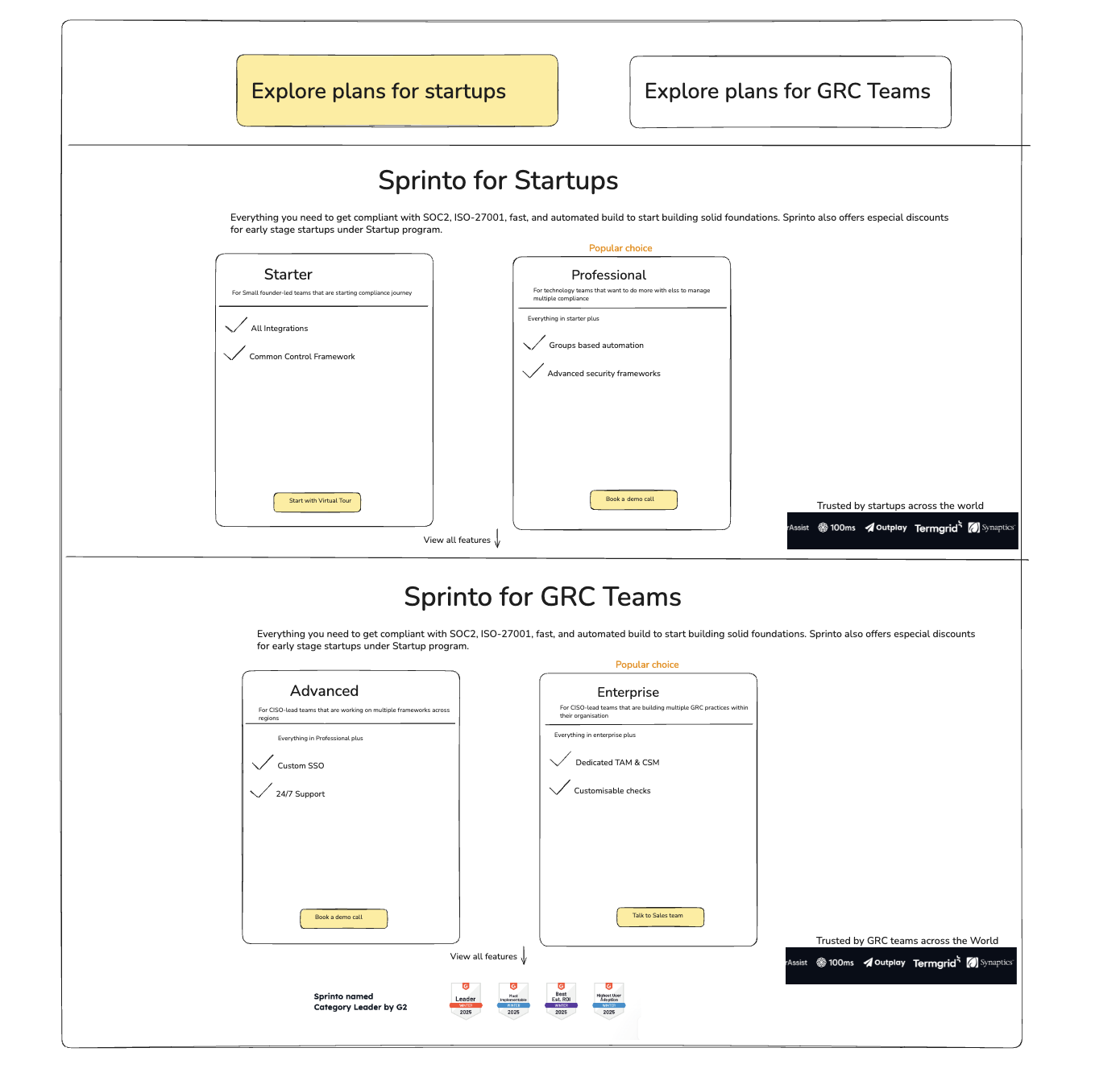
We’re making Sprinto’s pricing page publicly available on website — and gave it a complete overhaul to make it easier to explore, understand, and act. Sprinto doe
What’s New:
Split for Clarity
Two clear sections:
- Startups & SMBs: Starter, Professional, Advanced
- Mid-Market & Enterprise: Advanced, Enterprise (with focus on customization)
Popular Plans Highlighted
Middle tiers like “Professional” and “Advanced” are visually marked as most popular — helping users make faster, confident choices.
No Pricing Upfront
Pricing stays behind “Request Demo” and “Book a Virtual Tour” CTAs — to reduce friction and prompt conversation.
Trust Boosters
Client logos, G2 badges, and testimonials build credibility and social proof.
Feature Bundling That Makes Sense
Plans showcase features in clear groups. Upgrades feel valuable, not just expensive.
Try Before You Buy
Strong “Virtual Tour” invites tap into the ownership effect — once users see the platform, they’re more likely to convert.
Why It Works:
- Middle-option bias encourages smarter plan selection
- Trust signals reduce hesitation
- No price wall increases demo conversions
- ICP-specific structure guides users more efficiently
Result:
A cleaner, clearer, and more persuasive pricing experience — designed to convert leads, build trust, and support scale across user segments.
Brand focused courses
Great brands aren't built on clicks. They're built on trust. Craft narratives that resonate, campaigns that stand out, and brands that last.


All courses
Master every lever of growth — from acquisition to retention, data to events. Pick a course, go deep, and apply it to your business right away.





Courses
Built by Leaders From Amazon, CRED, Zepto, Hindustan Unilever, Flipkart, paytm & more










Crack a new job or a promotion with ELEVATE
Designed for mid-senior & leadership roles across growth, product, marketing, strategy & business




Learning Resources
Browse 500+ case studies, articles & resources the learning resources that you won't find on the internet.

Patience—you’re about to be impressed.